30-min BJJ kettlebell workout
This 30-minute BJJ kettlebell workout is a high-intensity conditioning program designed to build the explosive power and work capacity you need for Brazilian Jiu-Jitsu. The circuit format mimics the intensity of rolling with short bursts of work followed by brief recovery periods.
The workout consists of 4 kettlebell exercises performed for 1 minute each, followed by 1 minute of rest. You'll complete this circuit 5 times for a total of 25 minutes of work. Add a 5-minute warm-up and you have a complete 30-minute training session that fits perfectly into busy training days.
This 30-minute kettlebell workout for BJJ builds cardiovascular endurance, muscular endurance, and mental toughness. The format teaches you to work hard even when fatigued, which directly translates to maintaining technique and pressure during late rounds in competition or intense training sessions.
Why circuit training for BJJ?
Circuit training is one of the most effective methods to build BJJ-specific conditioning. Unlike traditional strength training where you rest 2-3 minutes between sets, circuits keep your heart rate elevated and train your body to recover quickly between bursts of effort. This mirrors the demands of rolling.
This 30-minute kettlebell workout trains both your aerobic and anaerobic energy systems. The 1-minute work periods push your anaerobic capacity while the short rest periods train your ability to recover quickly. Over time, this builds the kind of endurance that lets you maintain high output in the late rounds of a tournament.
The mental component is huge too. Learning to push through fatigue while maintaining good form on your kettlebell exercises teaches you to stay technical when you're exhausted on the mats. This is the difference between keeping position and getting swept in round five.
TRAINING TIP: Use a timer app or interval timer. Set it for 1 minute work, 1 minute rest, and 5 rounds. This keeps you honest and ensures you're getting the full conditioning benefit of the circuit format.
The 30-minute BJJ kettlebell workout
Warm-up (3-5 minutes)
- •Joint mobility: Arm circles, hip circles, bodyweight squats (2 minutes)
- •Light cardio: Jumping jacks or high knees (1 minute)
- •Kettlebell-specific: Light swings with warm-up weight (2 minutes)
Circuit format
Complete 5 rounds of:
- 1.Exercise 1: 1 minute
- 2.Exercise 2: 1 minute
- 3.Exercise 3: 1 minute
- 4.Exercise 4: 1 minute
- 5.Rest: 1 minute
Total time: 5 rounds × 5 minutes = 25 minutes of work + 5 minute warm-up = 30 minutes
Exercise overview and rep goals
| Exercise | Time | Rep Goal | Notes |
|---|---|---|---|
| Kettlebell Swings | 1 min | 15+ | Explosive hip drive. Focus on power output, not speed. Use 16-24kg. |
| Goblet Squats | 1 min | 10+ | Controlled tempo. Go deep, maintain form. Use 16-24kg. |
| Push Press (alternating) | 1 min | 10+ | 5+ per arm. Switch as needed. Use 16-20kg. |
| Rows (alternating) | 1 min | 12+ | 6+ per arm. Strict form. Use 16-24kg. |
| Rest | 1 min | - | Walk around, breathe, prepare for next round. |
REP GOALS: These are minimum targets to hit each round. The goal is consistency across all 5 rounds. If you hit 20 swings in round 1, aim for 18-20 in rounds 2-5, not 25 in round 1 and 12 in round 5. Pick a weight that lets you hit the minimum consistently.
Detailed exercise breakdown
Exercise 1: Kettlebell Swings (1 minute)
Start with explosive swings to get your heart rate up immediately. Focus on powerful hip drive and keeping your core tight. This builds the posterior chain power essential for takedowns and explosiveness in scrambles. Use 16-24kg. Don't pace yourself too much in round one, you want to be working hard from the start.
Exercise 2: Goblet Squats (1 minute)
Hold the kettlebell at chest height and perform controlled squats. Go as deep as you can while maintaining good form. This builds leg endurance and reinforces proper squatting mechanics crucial for guard work and shooting takedowns. Use 16-24kg. Keep moving the entire minute even if you need to pause at the top for a few seconds.
Exercise 3: Kettlebell Push Press (1 minute, alternating arms)
Clean the kettlebell to the rack position, use a slight dip and drive to press overhead. Alternate arms each rep. This builds pressing strength and shoulder endurance needed for maintaining top pressure and frames. Use 16-20kg. Switch arms when you need to, don't try to do 30 seconds per arm if you're gassing out.
Exercise 4: Kettlebell Rows (1 minute, alternating arms)
Single arm rows with strict form. Pull the kettlebell to your hip, squeeze your lat at the top. Alternate arms each rep or switch halfway through. This builds the pulling strength essential for guard retention and back control. Use 16-24kg. This is your "recovery" exercise before the 1-minute rest, so maintain good form and breathing.
INTENSITY GUIDE: Round 1 should feel challenging but manageable. By round 3, you should be working hard. Rounds 4 and 5 are where you build mental toughness. The goal is to maintain consistent output across all 5 rounds, not to sprint in round 1 and die in round 5.
Cool down (2-3 minutes)
Walk around for 1-2 minutes to bring your heart rate down gradually. Follow with light stretching focusing on hips, shoulders, and lower back. Hold each stretch for 30 seconds. This helps with recovery and prepares you for your next training session.
How to scale this circuit
This 30-minute kettlebell circuit can be scaled up or down based on your fitness level and how you're feeling that day. Here are several ways to adjust the intensity:
Make it easier
- •Reduce rounds: Do 3-4 rounds instead of 5 to start. Build up to 5 rounds over several weeks.
- •Lighter weight: Use 12kg or even 8kg if needed. Better to complete all rounds with good form than to use too much weight and break down.
- •Longer rest: Take 90 seconds of rest instead of 60 seconds between rounds.
- •Shorter work periods: Do 45 seconds of work instead of 1 minute per exercise.
Make it harder
- •Heavier weight: Use 24-32kg if you can maintain good form throughout all 5 rounds.
- •Less rest: Reduce rest to 45 seconds between rounds. This significantly increases the conditioning demand.
- •Add a round: Complete 6 rounds instead of 5 for an even longer conditioning session.
- •Two kettlebells: Use two kettlebells for the squats, presses, and rows. This significantly increases the load.
PROGRESSION TIP: Start conservative. It's better to finish strong and think "I could have done more" than to blow up in round 3 and barely finish. Once you can complete all 5 rounds with good form and consistent output, then add weight or reduce rest periods.
How to program this circuit
This 30-minute BJJ kettlebell workout works great as a standalone conditioning session or as supplemental work on lighter BJJ training days. Here's how to fit it into your training schedule:
- •1-2 times per week: This is ideal for most BJJ athletes. Do it on days when you're not doing hard sparring. The high intensity of the circuit means you need adequate recovery.
- •Morning sessions: Great for morning training when you have BJJ later in the day. Give yourself at least 6-8 hours between the circuit and rolling.
- •Rest days: Can be done on BJJ rest days to maintain conditioning without the impact of rolling.
- •Competition prep: Great for fight camps when you want to build conditioning. Do it 2x per week in the early camp, then reduce to 1x per week as you get closer to competition.
RECOVERY NOTE: This workout is more demanding than traditional strength sessions. Listen to your body and don't push through if you're already overtrained from hard BJJ sessions. Quality training beats junk volume every time.
Final thoughts on circuit training
This 30-minute BJJ kettlebell workout is designed to be brutally effective without beating you up. The circuit format builds both physical conditioning and mental toughness. Learning to push through when you're tired in training makes it easier to dig deep when you need it in competition.
The beauty of this workout is its simplicity. Set a timer, pick your weight, and get to work. No overthinking, no complicated progressions. Just consistent effort over 30 minutes that builds the engine you need for BJJ.
Remember that conditioning work should support your BJJ training, not interfere with it. If this circuit leaves you too sore to train properly, scale it back. The goal is to show up to class stronger and better conditioned, not exhausted and broken down.
Train smart, push hard when it counts, and see you on the mats.
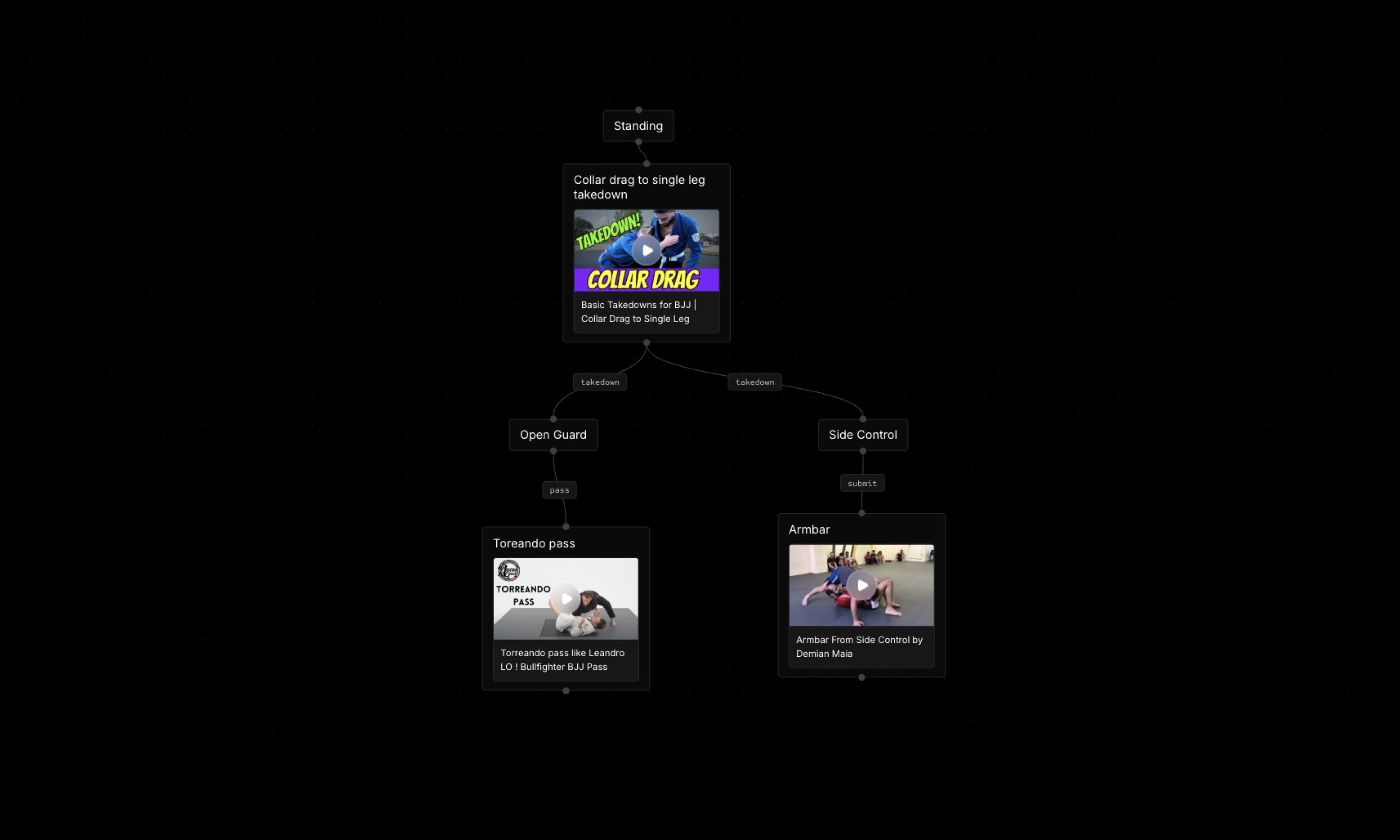
Visualise your game plan
Build flowcharts of positions, techniques, and transitions to map out your BJJ strategy
Create visual flowcharts with positions and techniques
Connect transitions and map decision trees
Link instructional videos and resources to each move