What makes the BJJ belt system unique
The BJJ belt system is different from other martial arts because of the dedication, time, and skills needed to progress. It started from Judo but has grown into something unique, focusing on technique, practical skills, and real-world situations.
Progression through the belts can take years, which makes earning each one a significant achievement. Unlike some other martial arts, Brazilian Jiu-Jitsu focuses heavily on live training and adaptability. You learn to apply techniques in real-time scenarios against resisting opponents.
BJJ belts are markers of personal development. Each belt color represents the time and energy you've invested in mastering techniques and honing skills that extend beyond the mats. The journey tests your patience, resilience, and perseverance.
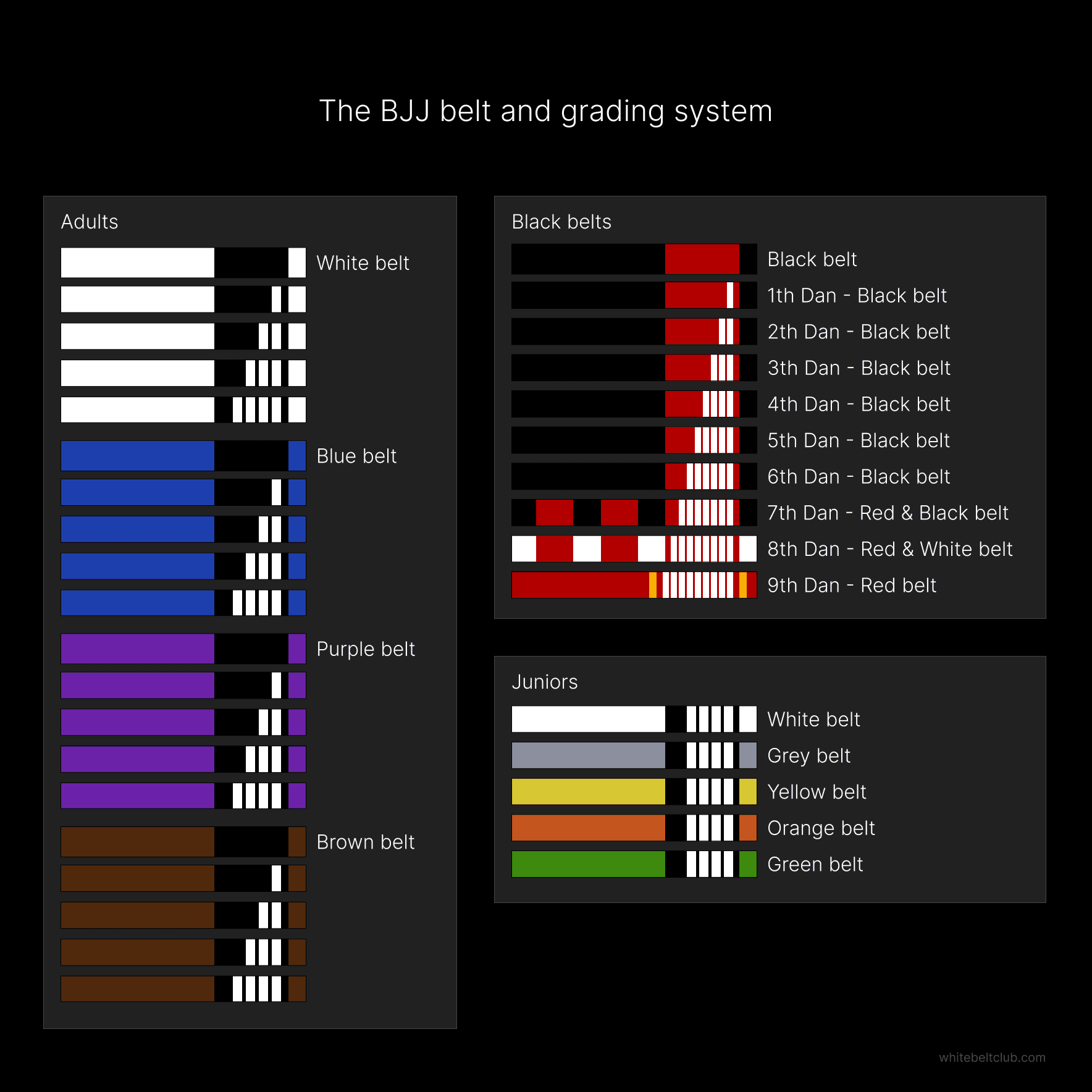
How long does it take to get a black belt in BJJ?
Most practitioners take 10-15 years of consistent training to earn a black belt. That's significantly longer than most martial arts. The time varies based on training frequency, natural aptitude, competition success, and your instructor's standards.
Some people train 2-3 times per week and progress slowly but steadily. Others train 5-6 days per week and progress faster. Your instructor evaluates you based on technical skill, mat time, and how you perform against live resistance.

White Belt
White belt is where every practitioner starts. At this level, you learn the basics: foundational movements, positions, and concepts. The focus is on understanding the core principles of balance, posture, and defense. Embrace learning from every mistake.

Blue Belt
Reaching blue belt means you understand the basics. You've developed enough skill to start effectively defending yourself and have a firm grasp of fundamental techniques. At blue belt, focus on expanding your knowledge, experimenting with techniques, and learning how to transition between positions. This is often where people quit because the initial excitement wears off and progress feels slower.

Purple Belt
The purple belt is a time to develop a unique style. At this stage, you're refining your techniques and becoming more creative on the mat. Purple belts often take on more responsibilities in the gym, helping teach lower belts, which helps solidify their understanding. You become comfortable with your approach to BJJ and fine-tune both offense and defense.

Brown Belt
Brown belt is the final step before black belt. You focus on refining your game, addressing weak points, and mastering your strengths. Brown belts have a well-rounded skill set and often guide lower belts during training sessions. At this level, your transitions are seamless and techniques are applied with precision. Many brown belts can compete effectively against black belts.

Black Belt
Earning a black belt in Brazilian Jiu-Jitsu represents years of dedication, practice, and mastery of the art. A black belt practitioner knows how to execute techniques and understands when and why to use them effectively. Black belts contribute to the BJJ community by teaching, mentoring, and continuing their own journey of learning.
Earning a black belt is not the end. It's the beginning of a lifelong commitment to Brazilian Jiu-Jitsu. After achieving a black belt, you can progress through the 1st to 6th degrees, each of which can be awarded after three years of active practice and contribution.

Coral Belt (7th Degree)
The 7th-degree black belt is often referred to as the "coral belt," which is visually represented by a belt that is red and black in color. To be eligible for a 7th-degree black belt, a practitioner must generally hold the 6th-degree black belt for at least seven years. This rank represents a significant level of expertise, experience, and contributions to BJJ, including leadership, coaching, and promoting the sport worldwide.

Coral Belt (8th Degree)
The 8th-degree black belt is also a coral belt but is represented by a belt that is red and white in color. Practitioners must have held the 7th-degree black belt for at least seven years to be promoted to the 8th degree. This belt signifies further mastery and contributions to the art and is awarded to those who have continued to demonstrate dedication at the highest levels of the sport.

Red Belt (9th & 10th Degree)
The 9th-degree black belt is represented by a solid red belt. This rank is often referred to as the "grandmaster" rank and is awarded to practitioners who have dedicated their lives to the advancement of BJJ. It is an acknowledgment of their lifelong service and impact on the art.
The 10th-degree red belt is the highest possible rank in Brazilian Jiu-Jitsu. This rank is extremely rare and is generally reserved for the original pioneers of the art, specifically the founders of BJJ, such as Carlos Gracie Sr., Oswaldo Fadda, and others of that generation.
How belt stripes work in BJJ
Progression through the BJJ belt system requires dedication and time. Each belt represents skill and experience, and instructors carefully evaluate students before promotion. Belt stripes are a vital part of this journey, serving as smaller markers of progress within each belt.
Stripes provide a sense of progress during the often long journey between belt promotions. They're mini-achievements that help measure development and show you're heading in the right direction. Most gyms award up to four stripes per belt before promoting you to the next color.
What instructors look for in promotions
Promotions depend on many factors. Your instructor evaluates your technical mastery, consistency in training, and attitude on the mats. Some gyms also consider competition success. You need to show proficiency in both offensive and defensive techniques and demonstrate the ability to apply these techniques during live sparring against resisting opponents.
Your instructor watches how you handle adversity, whether you help training partners, and if you show up consistently. Technical skill matters, but so does being a good training partner and contributing positively to the gym culture.
Testing and assessment
Unlike many martial arts, BJJ rarely has formal belt tests. Your instructor observes you during regular training. They evaluate your technical skills, respect for training partners, and effectiveness under pressure. Higher belts may have more formal assessments, depending on the gym.
This means every class is essentially a test. How you perform during sparring, how you treat your training partners, and how you handle getting tapped out all factor into your progression. You can't fake your way through a BJJ promotion.
How stripe promotions work
Each gym has its own criteria for awarding stripes. Some focus on time spent training, while others look at demonstration of specific techniques or abilities. Typically, there are four stripes per belt before progressing to the next belt color. The focus is on growth in skill, understanding, and contributions to the community.
Don't obsess over stripes. Some instructors hand them out regularly, others rarely award them. Some gyms don't use stripes at all. Focus on improving your game rather than counting stripes on your belt.
Tips for advancing through the belt system
Show up consistently
Consistent practice is key to advancing in BJJ. Training regularly, even if it's only a few times a week, helps you retain techniques and build muscle memory. Show up when you don't feel like it. The people who earn their belts fastest aren't always the most talented, they're the ones who show up consistently.
Set realistic goals
Set short-term and long-term goals for your BJJ journey. This keeps you motivated and focused. Goals can range from improving a specific technique to participating in competitions. Don't make belt promotion your only goal. Focus on getting better at specific positions or submissions. The belt will come when you're ready.
Learn how to tie your belt
Even the simplest things matter in BJJ, like learning how to tie your belt properly. A well-tied belt shows respect for the discipline, keeps you comfortable during training, and can even boost your confidence.
Be patient with yourself
BJJ is a marathon, not a sprint. Progress can feel slow. Some days you'll get tapped by everyone. Some weeks you'll feel like you're getting worse instead of better. That's normal. Focus on enjoying the journey, stay open to learning, and remember that everyone progresses at their own pace.
Ask for feedback
Ask instructors and experienced teammates for feedback. Understanding your weaknesses is crucial for improvement. Most higher belts are happy to help if you ask specific questions. Engaging with the community will keep you connected and motivated.
Embracing the journey
The BJJ belt system represents growth, discipline, and the challenges that shape you as a practitioner. Each belt earned represents countless hours of effort, both on and off the mat.
Brazilian Jiu-Jitsu teaches resilience, humility, and the importance of continuous learning. The friendships, lessons, and personal growth you experience during training are what make BJJ special. Stay committed, trust the process, and keep moving forward.
Whether you're just starting out or nearing black belt, enjoy each step of the journey. True growth comes from focusing on learning and improvement, not chasing belt colors. The belt is just a piece of cloth that holds your gi together. What matters is who you become along the way.